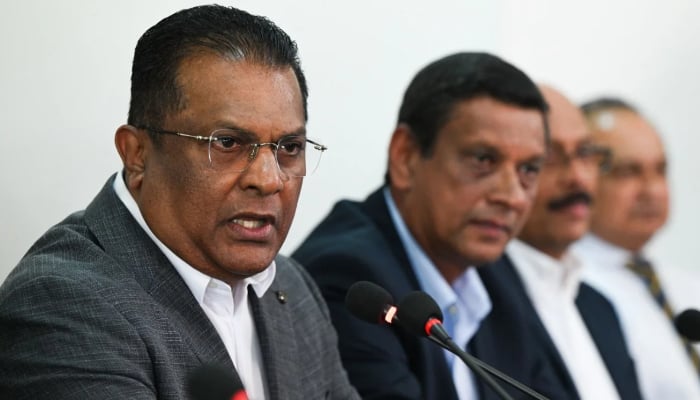
Sri Lanka Cricket Board president Shammi Silva and the organization’s executive committee officially resigned on Wednesday, as approved by a special committee meeting held a day earlier.
The development is understood to have followed a request by Anurakumara Dissanayake, who is said to have met Silva last Friday to negotiate a smooth exit amid mounting public pressure and allegations of financial irregularities.
The government is now expected to appoint an interim committee headed by former Member of Parliament Eran Wickramaratne. Former cricketers Siddath Wettimuni and Roshan Mahanama will also take part in the proposed formation, though no official announcement has been made.
The SLC confirmed the resignations in a media release, saying that Silva and all other office bearers have resigned with immediate effect and that the President and Sports Minister Sunil Kumar Gamage have been notified of these decisions.
Silva first took office in February 2019 after Thilanga Sumathipala. Initially considered a loyalist of his predecessor, he consolidated his power, winning four consecutive terms, three of them unopposed.
During his seven-year tenure, Sri Lanka enjoyed limited success on the field, including Asia Cup victories on both the men’s and women’s sides. However, sustainability proved elusive.
The men’s team suffered a significant drop in the rankings and disappointing campaigns at the 2023 ODI World Cup, where they finished ninth, and then exited the 2024 and 2026 T20 World Cups – the latter hosted by Sri Lanka.
The recent appointment of Gary Kirsten as head coach has not eased calls for a leadership change.
Despite frequently highlighting SLC’s financial strength and record revenues, Silva’s administration was continually marred by allegations of corruption and mismanagement.
Tensions peaked in late 2023 when then Sports Minister Roshan Ranasinghe tried to sack the board citing censored evidence of misconduct.
Although Silva was summarily removed, he was reinstated by the Court of Appeal, sparking a long-running conflict that ultimately contributed to Ranasinghe’s own removal.
Legal uncertainties continue to surround the current transition. Under the SLC Constitution, any vacancy shall be filled by appointment of one of the incumbent Vice-Presidents.
However, Jayantha Dharmadasa and Ravin Wickramaratne, who held those roles, have both resigned, complicating the process.
To navigate this, officials can rely on provisions in the Sports Act No. 25 of 1973, which allows the Minister of Sports to dissolve the governing body and establish interim arrangements.
However, such a move risks violating the International Cricket Council’s (ICC) strict non-interference policy.
The ICC has historically taken a firm stand against government interference in cricket administration.
In November 2023, Sri Lanka’s membership was suspended after the removal of the State Intervention Board, resulting in the loss of ICC funding and the relocation of the Under-19 World Cup.
In an apparent attempt to avoid a repeat, the current administration has sought to make resignations voluntary rather than enforced.
However, if the ICC determines that the move was politically influenced, the possibility of another suspension cannot be ruled out.
The governing body has previously rejected interim arrangements in Sri Lanka, including refusing to recognize a Wettimuni-led committee in 2015 and imposing strict deadlines during a similar intervention in 2018.
The government now faces a delicate balancing act – responding to public demand for reform while assuring the ICC that any interim system will only serve as a temporary step towards restoring constitutional governance.
Whether the resignations are accepted as internal decisions or seen as political interventions will ultimately determine Sri Lanka’s position in international cricket.