Most people believe that life changes in dramatic moments.
A lottery ticket.
A life-saving surgery.
A phone call with good news.
But sometimes, a life changes because one stranger simply decides to stop walking.
No cameras.
No applause.
No expectation of recognition.
Just one human being who looked at a suffering animal and thought:
“I can’t leave her here.”
That decision would completely rewrite the story of a dog who had almost disappeared from the world.
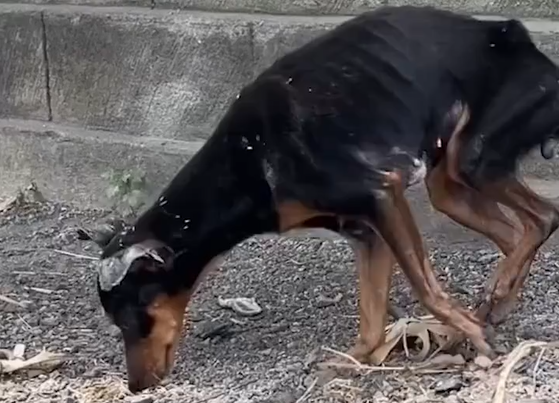
She Had Almost Become Invisible
There is something heartbreaking about stray animals that many people never notice.
They slowly become invisible.
Not because people literally cannot see them, but because they become part of the background.
People pass them every day on sidewalks, beside roads, outside restaurants, near markets, under abandoned buildings, and in empty parking lots.
Some people feel sad.
Some feel uncomfortable.
Many simply keep walking.
After enough days, weeks, or months, the animal becomes another ordinary sight.
Nobody asks where she came from.
Nobody wonders how long it has been since she had a proper meal.
Nobody imagines what it feels like to wake up every morning not knowing whether today will be the day hunger finally wins.
That was the reality for this dog.
She wasn’t born to live like this.
No puppy dreams of sleeping on cold concrete.
No animal chooses starvation.
Some are abandoned when families move away.
Others are left behind because they become sick.
Some are born on the streets and never experience the comfort of a home.
Whatever her story had been, it had led her here.
Alone.
Exhausted.
Starving.
Barely alive.
Hunger Does More Than Empty the Stomach
Most people think hunger is simply the feeling of wanting food.
Real starvation is something entirely different.
When an animal goes without enough nutrition for weeks or months, the body begins consuming itself just to survive.
Fat disappears first.
Then muscle.
The legs become weak because there is no strength left to support the body.
The ribs become sharply visible beneath the skin.
The hips protrude.
The spine becomes painfully defined.
Eventually, even standing requires more energy than the body can produce.
That is exactly what rescuers often see in severely neglected dogs.
They are not simply thin.
They are physically running out of life.
This dog had reached that point.
She lay on the ground because getting up had become almost impossible.
Every movement cost precious energy.
Every breath seemed like hard work.
The sparkle that healthy dogs naturally have in their eyes had been replaced by exhaustion.
She wasn’t waiting for someone.
She wasn’t expecting help.
She was simply trying to survive another hour.
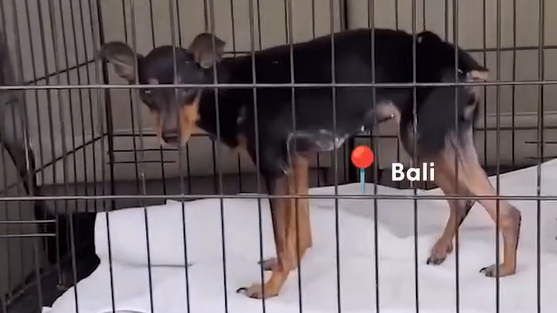
The Silent Pain of Living on the Streets
Starvation was only one part of her suffering.
Street animals face dangers every single day that most pet owners never have to imagine.
Cars speed past without slowing down.
People chase them away.
Extreme heat burns their paws.
Winter nights steal body heat.
Rain leaves them soaked with nowhere to hide.
Injuries often go untreated.
Parasites weaken already fragile bodies.
Even finding clean drinking water can become a daily challenge.
For female dogs, life is often even harder.
Pregnancy, nursing puppies, protecting them from danger, and trying to find enough food creates a cycle that many never escape.
Researchers and animal welfare organizations have documented that chronic starvation also weakens the immune system, making animals much more vulnerable to infections, parasites, and disease. A problem that begins with hunger quickly becomes a fight for survival.
Every day on the streets demands impossible choices.
Search for food.
Avoid danger.
Find shelter.
Stay alive.
Repeat tomorrow—if tomorrow comes.
Then Someone Finally Stopped
Hundreds of people may have passed that dog before.
Maybe thousands.
But on this particular day, someone saw more than a starving stray.
They saw a living soul.
Instead of saying,
“Someone else will help.”
They became that someone.
The rescuer approached slowly.
Not because the dog was aggressive.
Because frightened animals often fear kindness as much as they fear danger.
When survival has taught you that humans can hurt you, trust disappears.
The dog watched carefully.
She had no reason to believe this person was different.
But something about the gentle movements…
The calm voice…
The patience…
Made her stay still.
Sometimes rescue begins not with lifting an animal.
It begins with earning permission.
The First Safe Place in a Very Long Time
The journey to safety was only the beginning.
The dog was carefully transported away from the place where she had nearly died.
For the first time in what may have been months, she was somewhere quiet.
There was no traffic.
No constant fear.
No competition for scraps of food.
No desperate search for shelter.
Instead, there was a clean blanket.
Fresh water.
Nutritious food.
People who looked at her with compassion instead of indifference.
To many of us, these things seem ordinary.
To an abandoned animal, they feel extraordinary.
Why Rescuers Never Feed Starving Animals Too Quickly
One of the biggest misconceptions people have is that severely starving animals should simply be given as much food as possible.
In reality, experienced veterinarians know that this can be dangerous.
Animals that have experienced prolonged starvation often require carefully managed feeding schedules.
Their digestive systems need time to adapt.
Small, frequent meals are usually much safer than one enormous meal.
Hydration must also be monitored carefully.
Veterinary professionals often perform physical examinations, treat parasites, clean wounds, administer vaccinations when appropriate, and evaluate underlying illnesses before creating a recovery plan.
Recovery is medicine.
Recovery is nutrition.
Recovery is patience.
Healing Takes Longer Than Most Videos Show
Rescue videos often compress weeks into a few minutes.
The transformation looks instant.
Reality is much slower.
Some days show progress.
Others bring setbacks.
There are moments when the animal refuses food.
Moments when infections appear.
Moments when fear returns.
Recovery is rarely a straight line.
Every pound gained is earned.
Every healed wound takes time.
Every night of peaceful sleep repairs a body that spent months living under constant stress.
The strongest medicine isn’t always found in a bottle.
Sometimes it’s consistency.
Someone showing up every day.
Feeding.
Cleaning.
Comforting.
Waiting.
Believing.
The First Tail Wag
Every rescuer remembers certain milestones.
The first time the dog eats willingly.
The first time she drinks confidently.
The first time she sleeps deeply.
The first playful movement.
The first bark.
The first tail wag.
These moments may seem small.
But for animals recovering from severe neglect, they represent something remarkable.
Hope returning.
Scientists studying animal behavior have long recognized that dogs are highly social animals capable of forming deep emotional bonds with humans. When treated consistently with care rather than fear, many rescued dogs gradually rebuild trust despite experiencing trauma.
That trust cannot be demanded.
It must be earned.
A Body Can Heal Faster Than a Heart
As the weeks passed, her ribs slowly became less visible.
Her muscles returned.
Her coat became thicker.
Her eyes became brighter.
But physical recovery was only part of the journey.
Emotional healing often takes much longer.
Abandoned animals frequently hesitate before accepting affection.
Some flinch when hands move toward them.
Some refuse eye contact.
Some remain anxious around loud noises.
This isn’t stubbornness.
It is survival.
Trauma changes behavior.
Fortunately, love changes behavior too.
Not overnight.
Not magically.
But gradually.
The Moment Everything Changed
One day, something happened that no medical test could measure.
The dog leaned into her rescuer.
Not because she was forced.
Not because she expected food.
Simply because she finally felt safe.
That small movement represented months of healing.
Trust had returned.
She no longer believed every human was a threat.
She had discovered that kindness still existed.
Sometimes recovery is not measured by weight gain.
It is measured by confidence.
The Crisis Facing Stray Animals Worldwide
This story is emotional because it is personal.
But it is also part of a much larger global problem.
Animal welfare organizations estimate that hundreds of millions of dogs live on the streets around the world. While conditions vary from country to country, many face hunger, disease, injury, harsh weather, and limited access to veterinary care.
Rescue organizations work tirelessly, but they cannot solve the problem alone.
Communities also play a role.
Responsible pet ownership.
Spaying and neutering programs.
Vaccinations.
Adoption instead of purchasing pets from irresponsible breeders.
Support for local shelters.
Public education.
Every one of these efforts helps reduce suffering.
Compassion Doesn’t Always Require a Rescue Vehicle
Not everyone has the resources to rescue an animal.
Not everyone can adopt.
Not everyone has veterinary experience.
But everyone can choose compassion.
You can place a bowl of clean water outside during hot weather.
You can report injured animals to local rescue organizations.
You can donate food or blankets to shelters.
You can volunteer your time.
You can encourage responsible pet ownership.
Sometimes the smallest act becomes the reason an animal survives another day.
The Lesson Hidden Inside This Story
It would be easy to say this is simply a story about a dog.
It isn’t.
It is a story about choices.
One choice to stop.
One choice to care.
One choice to believe that a life still mattered, even when everyone else had looked away.
The rescuer didn’t change the entire world that day.
Wars continued.
Problems remained.
Life carried on.
But for one starving dog lying on the ground, everything changed.
Her world changed completely.
She no longer had to wonder where her next meal would come from.
She no longer had to fear every passing stranger.
She no longer had to sleep alone in the cold.
She had safety.
She had care.
She had hope.
And perhaps that is the greatest reminder of all.
We often underestimate the power of ordinary kindness because we measure it by how many lives it reaches.
Real compassion is not measured that way.
Sometimes changing one life is enough.
Because to the one being saved, it is not just a rescue.
It is an entirely new beginning.
And perhaps the world becomes a little kinder every time someone decides that no living creature should be left behind.