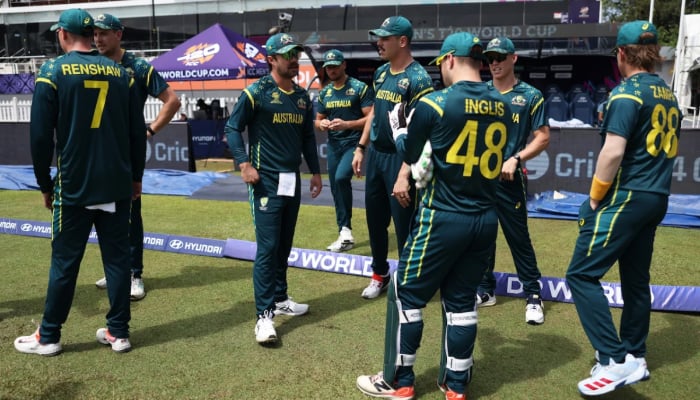
MELBOURNE: Australia’s disastrous first-round exit from the T20 World Cup, branded as one of the most dangerous campaigns in the country’s limited-overs history, has forced a major rebuild for the former white-ball titans.
Battered by injuries, out-of-form players and minimal preparation, Mitchell Marsh’s side suffered humiliating defeats against Zimbabwe and Sri Lanka. Their fate was sealed on Tuesday after a wash-out game ended an absolutely disastrous campaign.
Once revered for their ability to perform on the biggest stages, the 2021 T20 champions and six-time 50-over World Cup winners appeared rudderless.
For the first time in years, they took to the field without the leadership and bowling firepower of their legendary “big three” pacers, with Mitchell Starc retired from T20Is and Pat Cummins and Josh Hazlewood sidelined by injuries.
The relegation has left the team facing a dead rubber against minnows Oman, but more importantly, tough questions from former players and pundits over selection and team management.
“Massive challenges lie ahead and this campaign spells out in big bold pen that Australia is not as stock as it thinks,” local cricket writer Robert Craddock wrote in Wednesday’s Courier Mail.
The timing of the collapse couldn’t be worse. With Australia slated to host the next T20 World Cup in 2028, the most immediate prize is on the horizon as cricket returns to the Los Angeles Olympics in 2028.
The final qualification system for the six-nation Olympic Games is yet to be finalised, but Australia has done itself no favors.
World rankings are expected to play a key role in determining automatic qualification, and Australia’s rating will drop following this early exit.
Trans-Tasman rivals New Zealand, who have qualified for the Super Eight stage, will be emboldened and could snatch Australia’s place at the Games.
Beyond rankings, the tournament has exposed a deeper problem: the sporting death of a generation of champions. Many aging stars struggle to stay fit and are approaching the twilight of their lives.
Hazlewood has been sidelined for months with Achilles and hamstring problems, while Test and ODI captain Cummins has managed just one Ashes Test since the tour of the West Indies in mid-2025.
Master batsman Steve Smith, who was included in the World Cup squad as a late injury replacement but left out of the playing XI, declared his ambition to win an Olympic medal in LA.
However, he will be 39 years old when the game starts. Other veterans, including all-rounders Marcus Stoinis and Glenn Maxwell – stalwarts of Australia’s white-ball dominance – are of similar vintage.
While the selectors have made efforts to blood the new generation, some have consistently performed at a high level to instill confidence.
Pacers Nathan Ellis, Ben Twarshuis and Xavier Bartlett received rough treatment from the batsmen during the World Cup, while young all-rounder Cooper Connolly’s miserable run with the bat continued in Sri Lanka.
T20 cricket has never been Australia’s highest priority and this early exit will not prompt a root-and-branch review like the Ashes defeat.
However, with the Olympics and World Cup on the horizon, Australia have no choice but to embark on a significant rebuilding of a white-ball team whose luster has faded.