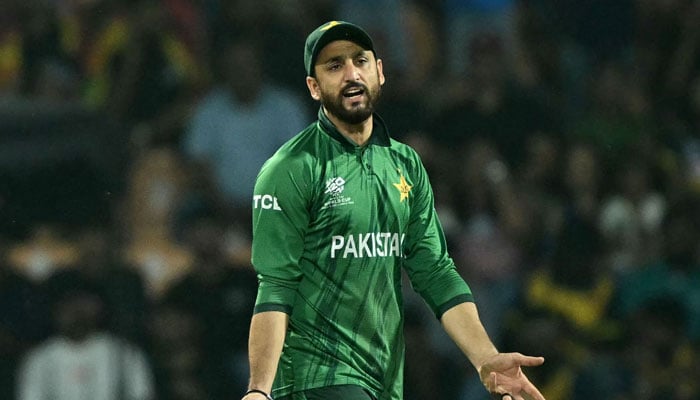
KANDY: Pakistan captain Salman Ali Agha admitted that the consistent struggles of the middle order are a long-term “problem” for his side after they were knocked out of the 2026 ICC Men’s T20 World Cup despite a narrow win over Sri Lanka in the last Super Eight match at the Pallekele International Cricket Stadium on Saturday.
The 2009 champions, who picked up just one point from two matches in their Super Eights campaign opener against New Zealand, needed to beat Sri Lanka by a sizeable margin to match the Blackcaps’ net run rate to qualify for the semi-finals alongside leaders England.
Batting first, Pakistan posted a mammoth total of 212/8 in their 20 overs, aided by a mammoth opening partnership of 176 runs from Sahibzada Farhan and Faqar Zaman.
At 200/3 after 18 overs, the Green Shirts could have put up an even bigger total against Sri Lanka, but a failure of their middle-order halted the run as they managed 12 runs in the final two overs, during which they lost five more wickets.
The collapse against Sri Lanka extended the struggles of Pakistan’s middle-order batsmen in the ongoing tournament, during which none of them managed to score a half-century.
Reflecting on his team’s campaign in the T20 World Cup 2026, Pakistan captain Agha acknowledged their series of batting failures, particularly in the middle order, promising to address them after the match.
“We didn’t bat well throughout the match. It would have been better if we had more support for Farhan. The middle order has been a problem for a few years and we have to look at that,” Agha said in the post-match briefing.
Despite the tension of their innings, Pakistan had a realistic chance of qualifying for the semi-finals by restricting Sri Lanka to 147 or less, but half-centuries from Pawan Ratnayake and Dasun Shanaka lifted the home side to 207/6, and Agha insisted the snow factor prevented them from executing their plan.
He also supported mystery spinner Usman Tariq, who suffered a rare loss with the ball as he went wicketless and conceded 43 runs in his four overs.
“It was always a challenge after losing the toss because of the snow. It would have been a different story if the toss had been won. The snow was a factor. We couldn’t execute the plans. Usman had an off day; it could have happened,” Agha said.
“We didn’t finish the way we wanted. We batted well for 18 overs and the opposition did well in the other two. Even 160 would have been difficult to defend,” he added.
Later in the post-match press conference, Agha said he and head coach Mike Hessen took full responsibility for the team’s performance, which he described as “below average”.
“If I were to summarize the whole match, I think we played below average cricket,” Agha said.
“We have not qualified for the semi-finals in the last four ICC tournaments because we have not made the right decisions at crucial moments.
Coach and I will take full responsibility for this performance.