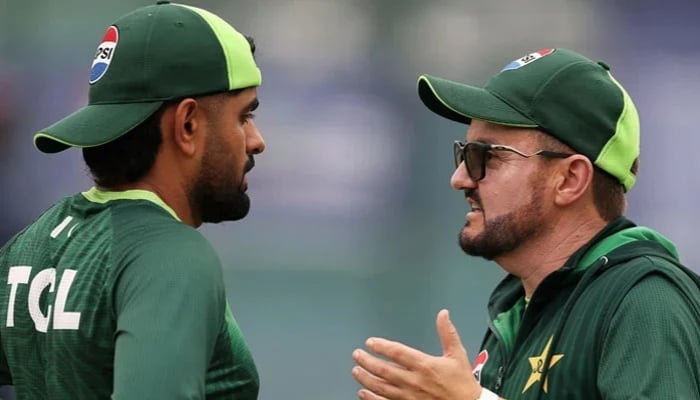
Former South Africa captain Faf du Plessis has called for honest discussions between Pakistan star Babar Azam and head coach Mike Hesson, insisting the team must find a way to unleash the batsman’s full potential in the modern T20 landscape.
The call came after Hesson, speaking ahead of Pakistan’s wash-out match against New Zealand, pointed out that Babar’s strike rate during the powerplay in the recent T20 World Cup was less than a run per ball.
The coach suggested that the batter’s optimal role in the team is now “in the middle” of the innings.
Appearing on a local sports programme, Du Plessis described Babur as a “world-class player” but admitted that the rapid evolution of T20 cricket has left him behind in terms of scoring tempo.
“I think all great players build their careers at different points,” he said. “We have known Baber as one of the best players in the world for a long time. The game of T20 cricket has progressed very fast in terms of strike rates and I think he is a bit behind in terms of strike rates.
“If you’re Mike Hesson, you’re trying to figure out the best way to introduce him to the game. On tricky surfaces, a strike rate of 120-130 is one’s role. ‘How do I get the best out of Babar Asam?’ Hesson would have thought. At 120-130, the game is far advanced. Now, you need to be 160 to 190 to 200 to increase that top six.”
However, du Plessis argued that the specific conditions of Pakistan’s World Cup campaign, with all matches played on slower surfaces in Sri Lanka rather than the flat tracks in India, could make a case for Babar’s traditional anchor role.
“There’s going to be a lot of spin on this ground and in that particular situation, there’s going to be a lot of value from someone like him in the middle and we can make sure he anchors the innings.”
However, Babar’s status as a cricket icon in Pakistan meant that his form was subject to intense public and media scrutiny. The pressure has affected the national selectors, who briefly dropped him from the squad during the Asia Cup campaign.
Hessen had earlier said that Babar needs to improve his game against spin and his overall strike rate to reclaim his place during the Big Bash League.
Nevertheless, in a move that surprised many, he was recalled to the squad before the end of the PBL and retained his place despite a modest run in the Australian tournament.
Du Plessis stressed that the foundation for any progress must be built on open dialogue.
“It starts with honesty,” Du Plessis said. “That’s the basis of any conversation that takes place. If you’re honest in your conversation (as a coach), everything flows from that, whereas if you as a coach or captain go around not telling the truth, it leads to holes that a player can jump into. So the nature of the conversation is always important.
“For a coach, it’s like, ‘Listen, these are the numbers. The numbers suggest this. This is where the game is at this moment. For us to win this World Cup or this tournament as a team, these are the areas where we think we’re a little bit weak.’
“When the stats are in front of a player, it’s very hard to go, ‘I don’t agree with you.’
After a decorated career that included 144 T20 matches and a record 86 matches as Pakistan’s T20 captain, the former Proteas skipper admitted that emerging at the age of 31 presents a unique challenge for Babur.
Drawing on his own experience, du Plessis cautioned against the temptation to resist change.
“The question you ask yourself is, ‘It’s worked for me so far, so why should I change?’ It’s the guy on one shoulder. But what I’m always looking at is, where can I get better? One of the obvious things that stood out from a statistical point of view was that in my first 15 balls against spin, my strike rate was 120, and against the seam it was 180. So a guy on your shoulder will say, ‘But that’s good. Are you striking at 140 (gross)? Why do you want to change?’ But (the other) would go, ‘You can do better, you can work on it.’
“The challenge of that is you’re uncomfortable because now you’re doing something you’ve never done in your whole life. I had to do it against spin. But it’s so easy in the nets because there’s no effect. I went for a hundred and tried to repeat what I did in the nets. You won.’ But the other guy said ‘stick to it.’ Growth happens when you’re uncomfortable.”
Du Plessis has continued to make changes in the CPL and found success translating them to the international stage, admitting the process was difficult but ultimately worthwhile. A culture of mutual respect is key, he stressed.
“It comes down to the tone you speak. If you’re aggressive or you point fingers, no one in the world is going to accept that. So it’s almost like a partnership in the conversation about how to get the best out of you and where you can improve to get the best result for the game.”