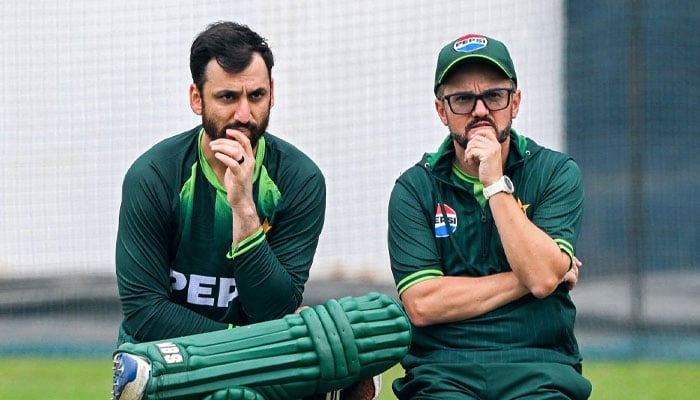
LAHORE: Pakistan white-ball head coach Mike Hesson wants to reshape the team’s leadership culture by creating multiple decision-makers rather than putting all the responsibility on the captain.
In an interview to a local sports website, Hessan said that Pakistan’s traditional leadership system, former captains would be isolated once they relinquished the role.
“We’re trying to work on having multiple leaders on one team,” Hessen said. “Culture is a culture of telling rather than an integrated developing culture.”
He insisted that players should continue to contribute to decision-making, even if not as captain, and added that Pakistan aims to create an environment where senior cricketers provide leadership and support on and off the field.
“You’re the captain, then you’re not, then you take every decision without making any decisions. We’re trying to change that. When Agha was the T20 captain he had so many players he could lean on and off the field, we’ll do the same with Shaheen,” he said.
The New Zealander, who previously oversaw New Zealand’s controversial captaincy transition from Ross Taylor to Brendon McCullum, believes building a wider leadership team will strengthen Pakistan in the long run.
Hesson also supported the Pakistan Cricket Board’s (PCB) revamped central contract model, describing it as a forward-thinking system designed to preserve the importance of Test cricket in the changing landscape of the modern game.
“When I talk about being jealous, we’ve tried to fit a model to the current environment rather than an arbitrary model that worked at least 10 years ago and roll it up. All of a sudden we’ll give somebody a normal contract or get somebody a red ball contract or something,” he said.
The 51-year-old acknowledged the growing challenge of balancing the financial realities of modern cricket with the traditional importance of the longer format.
Cricket boards around the world are exploring ways to value Test cricket more highly, while recognizing that player contracts need to better reflect the specific demands and impact of different formats.
“Every team around the world is trying to find a model that can realistically give some value to Test cricket. Most of the players around the world who play in all three formats still consider Test cricket as the pinnacle,” he said.
Hessen argued that due to the different skills and responsibilities required across Test and T20 cricket, it would be unfair to rate all players under the same fee structure.
“Contracts often don’t match that. It’s unfair to compare a Test match opening batsman with a guy who bowls in the powerplay and at the death in T20 cricket in the same way. It’s more realistic to compare them in terms of the way they play and the value they add to the team,” he concluded.