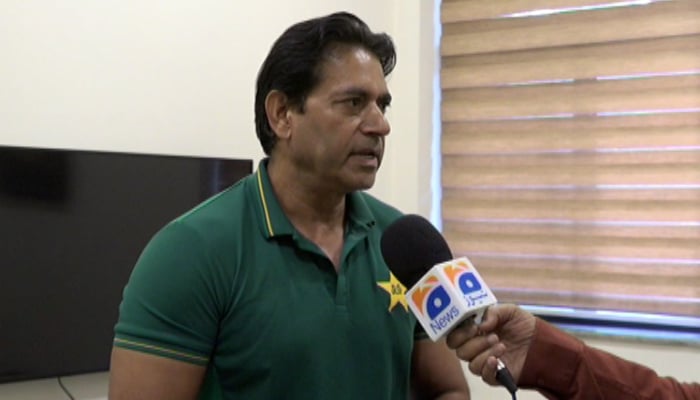
LAHORE: Pakistan Cricket Board’s (PCB) newly introduced format-based central contracts are the first step towards creating separate teams for Test, ODI and T20I cricket, Director High Performance Akib Javed said.
During an exclusive interview with Jio NewsAkib said the board was preparing to divide teams according to formats, arguing that modern cricket needed specialized players rather than cricketers trying to excel in all three formats.
“Format-based central agreement is the first step to separate teams for each format. This is just the beginning. Eventually, each format will have a separate team. We need to do this, immediately, Test and T20 teams should be separated because both formats cannot be played the same,” Akib said.
He explained that the previous central contract system was often disadvantageous to players as Test specialists were directly compared to T20 cricketers despite the requirements of different formats.
“Now, if a player plays only Test cricket, he will be judged against other Test players and compensated accordingly. Top performers in the Test category will earn up to PKR 4 million per month, while underperformers will get PKR 3 million to PKR 3.5 million. Similar performance-based categories will apply to Test-ODI and ODI-T20 players.
The former fast bowler further outlined the eligibility criteria for the new contracts.
Players must feature in at least six first-class matches to be eligible for a central contract in the Test division. For the Test-ODI category, a minimum of four First-Class and four List A matches are required.
Test-wing players will be issued no-holds-barred certificates (NOCs) for overseas four-day matches, while Test-ODI wing players will be allowed to participate in a franchise league.
Meanwhile, cricketers in the ODI-T20 category must play at least two List A matches and 10 domestic T20 matches and qualify for two NOCs.
Players contracted only in the T20 category are required to participate in domestic T20 matches, but otherwise can play franchise cricket. Aqib said the salary in the Test-ODI category could go up to PKR 4.8 million per month.
He emphasized that the goal is to encourage players to focus on their designated forms rather than trying to divide their attention equally across all forms of the game.
“It is not the intention to give equal importance to all the three formats. Players should focus on their division. We will encourage cricketers to stick to their format. Test players should focus on Test cricket as our performance in Test cricket is poor. It is unrealistic to expect someone who has played T20 cricket for three or four years to suddenly come back and win in Test cricket.
The former Pakistan fast bowler highlighted the importance of the newly proposed Division D, which has 16 to 20 emerging players.
“This will be a very important category. These players will receive a lot of attention and will be developed according to the format that best suits them from the beginning of their careers,” he explained.
Aqib admitted that changes to Pakistan’s T20I squad are inevitable ahead of the upcoming tournaments, including the Asia Cup.
“Changes need to be made in the T20 squad. The Asia Cup squad is ahead of everyone. The purpose of the central contract system is commitment. Commitment means playing international cricket while playing domestic matches,” he said.
“Failure to honor that commitment has hurt us. We finished eighth in the previous World Test Championship cycle and everyone can see where we stand now,” he added.
He said players who fail to meet domestic participation requirements relevant to their format could lose their contracts.
“If a player does not play the required first-class cricket according to his design, he will not get a contract and it will be suspended.”
Concluding his remarks, Akib clarified that the new categories are primarily based on salary and are designed to guide players to specialize in their respective formats.
Sohail Imran
comments