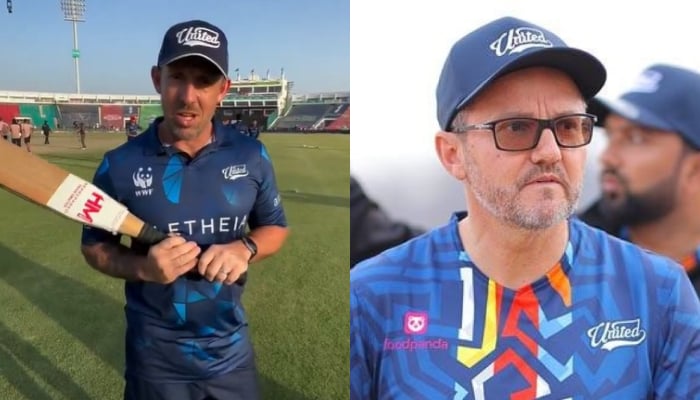
Former New Zealand wicketkeeper-batsman Luke Ronchi reflects on the differences in approach that shaped his coaching journey and his current role with Islamabad United, while drawing comparisons with former Pakistan white-ball head coach Mike Hesson.
Ronchi, who has been New Zealand’s batting coach for the past six years, joined the national set-up two years after Hesson’s departure.
Interestingly, their careers intersected in franchise cricket, with Hessan later taking charge of Islamabad United and leading them to the Pakistan Super League title in 2024 before stepping down.
The 45-year-old has now succeeded him in the franchise, marking a remarkable reversal of roles.
While acknowledging the natural comparisons between the two coaching paths, Ronchi was keen to emphasize that his methods and mindset were uniquely his own, shaped by his experiences as both a player and a coach.
“I have a different vibe than Mike Hessen,” Ronchi said. “It’s through our own experiences. That’s cricket. That’s what I love about the game now. It’s people’s different experiences. It would be a very boring game if everyone did the same thing all the time.”
He further explained that his role was not to replicate previous organizations, but to contribute his own identity to the group environment, despite external similarities.
“My job (not to replicate what Hessen did) is to bring my own character. When I look at where Hess was and where I was, I understand the comparison. But we are different personalities, we think about the game differently and we all have different paths, but it’s not that different.
Ronchi’s association with Islamabad United predated his appointment as coach. He represented the franchise as a player from 2018 to 2020 and played a limited role in their 2018 PSL title-winning campaign.
That season, he finished as the tournament’s top run-scorer, won the man of the match award in the final, and was also named the man of the match. He is the player with the highest powerplay strike rate in PSL history at over 182.
Reflecting on his transition from playing to coaching, Ronchi became interested in mentoring players while still active in international cricket with New Zealand, where he often supported teammates in a back-up capacity.
“It’s like what I did for a while with the New Zealand team,” Ronchi said. “Whenever I was on Test tours, I was a back-up player, so I helped the players anyway. I talked about bowling and cricket, their game plans and all that stuff.”
“Then when I finished international cricket, I entered the franchise system. I was not concerned about my own cricket, more like helping others and growing the game around the different teams I played with. I had some experience with that and it made me want to go in the direction of coaching,” he added.
His formal coaching journey began early in the Covid-19 pandemic when a position with New Zealand Cricket opened up.
He served as their all-format batting coach for six years, but the opportunity to return to Islamabad United offered a new challenge and an opportunity to expand his coaching experience.
Ronchi insisted that the team has grown significantly since his playing days, despite the continuity of some figures within the ownership structure, including captain Shadab Khan.
“There will be natural progressions in what happens in organizations,” Ronchi said. “I finished it in 2020, so now it’s effectively six seasons later. So it’s a big change. Shadab may still be there, but it’s also everyone’s development. Shadi is the cricketer he was then. The team is very different, it will be; that’s the nature of the new cricket team this year.
He said he focuses on blending his own coaching style with the franchise’s established culture to create a balanced and productive environment.
“But I also bring my style. You have to make sure I work the way I want to work, and the way Islamabad works and the way Shatab wants to work is aligned. It’s about making sure you all marry together and reap the benefits. Minds, everything works, but again, if you get the result you’re after, that’s great.”
Beyond the results, Ronchi highlighted the wider purpose of the Pakistan Super League, describing it as a platform to nurture future international cricketers rather than a purely winning-centric competition.
“Pakistan is the future of this tournament,” Ronchi said. “If you think about winning it every year, I think you’re a bit short-sighted. You want to win, but the bigger picture is to build players for Pakistan, which Islamabad has done so well.
He said that exposure to different playing conditions and experiences is essential for young cricketers aiming to succeed at the international level.
“What we’ve got here; we’ve got a good squad that can adapt to different situations and surfaces. I think that’s important not just for T20 cricket but for international cricket in general. It’s the PSL, so you need young Pakistani cricketers to play international cricket. It’s a good mindset to build for the future.”
One of the most successful teams in PSL history, Islamabad United have built a reputation for a calm and structured approach, which is reflected in their philosophy of “Timak Se” (with the head, not the heart). Ronchi believes this mindset closely aligns with his own coaching mindset.
“Why would I want to put extra pressure on guys,” he threw up his hands almost in bewilderment. “You have a passion, you want to do well and you want to help guys as much as you can, and you study the game in certain ways.”
“But I want to be relaxed and enjoy what I’m doing and for me as a coach when the men are playing, they’re the ones who are really doing the work and it’s my job to help them. I have to let them do it there and try to be as relaxed as I can,” he added.
He underscored his belief in a flexible, modern coaching approach that blends intuition with analysis rather than relying on a single method.
“If you know your cricket, I believe you can find players who understand what kind of game fits into the environment you are trying to create as a coach,” he said. “It’s the use of some different method rather than one way or the other.”
As he continues his dual responsibilities with New Zealand and Islamabad United, silverware has been elusive in international training so far, but he is confident of achieving success in both environments.
“It would be nice to win a white ball match,” he concluded.