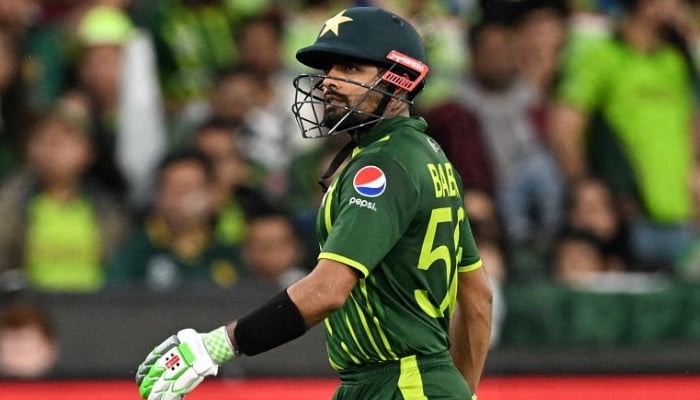
Cricket’s record books have a brutal honesty. They remember where you scored, not how many marks you scored. They remember when you hit, not how many times. After all, they remember who you scored against and what was at stake.
This is the uncomfortable reality that hangs over Babar Azam’s career in 2026, a career that by any statistical measure should be celebrated as one of the greatest of his generation, but which continues to call for a certain kind of scrutiny that his defenders find perplexing and his critics wholly earned.
Numbers mentioned by both parties
Babur’s supporters have a strong case on paper. In all T20 cricket, he scored an unbeaten 52-ball 100 for Peshawar Zalmi against Quetta Gladiators in PSL 2026 – second only to Chris Gayle’s 22 and 12 centuries behind David Warner and Virat Kohli.
He is the fastest bowler to reach 12,000 T20I runs in 338 innings, faster than both Kohli (360) and Gayle (344). His T20 average of 42.72 is the best among batsmen with at least 10,000 runs and he is the highest run scorer in PSL history with over 4,000 runs.
Especially in T20Is, the picture is more modest but still convincing. He has three T20I centuries.
In ODIs, he has scored 20 centuries – equaling Saeed Anwar’s Pakistan record – and has long been regarded as the world’s top three white-ball batsman when on form.
These are no small feats. They are, in a vacuum, the kind of numbers that secure a cricketer’s place in the pantheon.
But cricket is not played in a vacuum, and this is where the argument comes in. Because that’s the question that follows Babar – the one that followed him through the 2023 World Cup disappointment, Pakistan’s Super 8 run out of the 2026 T20 World Cup, stepping down as captain, status in Test cricket and a quiet fade from automatic selection.
It’s whether he hits them when the match, series or match is actually tied.
What is international cricket?
Franchise cricket has a limited memory. The PSL, IPL, PBL and CPL produce highlight reels, million-dollar contracts and social media respect, but they don’t create legends that pass between generations.
Not hearing stories about the 2018 Caribbean Premier League final. They have heard of Kapil Dev at Tunbridge Wells, Aravinda de Silva at Lahore in 1996, Dhoni’s helicopter six at Wankhede.
International cricket – especially the knockout stages of global tournaments – is the only arena where performances are consistently close.
Look out for Kohli. He holds the record for most runs in T20 World Cup history (1,292), most fifty-plus scores in the tournament (15), and most Man of the Match awards in T20 World Cup history (8).
The only player to win the man of the match award twice (2014 and 2016), he has scored 373 runs at an average of 93.25 in T20 World Cup knockout matches alone.
When India finally won the T20 World Cup in 2024, he scored a 59-ball 76 in the final after a quiet contest – and was named man of the match. A year later, in the 2025 Champions Trophy, which India also won, he scored an unbeaten century against Pakistan in the group stage and 84 in the semi-final against Australia.
A history-keeping scoreboard doesn’t care about the matches you got out cheaply; It cares about the nights on which the cup is handed out.
It is in this context that he overtakes Kohli in the list of T20 century scorers or Babar overtakes him in all T20 centuries. Kohli’s ledger is weighted towards sports that come to mind in cricket.
Chris Gayle, for all his mercenary reputation as a franchise, was central to two T20 World Cup victories for the West Indies (2012 and 2016) and a Champions Trophy title in 2004.
His 117 against South Africa in the 2007 T20 World Cup was his first century in men’s T20I cricket, and his 100 not out in 48 balls against England at Wankhede in the 2016 group stage – a World Cup, won by the West Indies – included 11 sixes, the most sixes in any T20 World Cup.
Sahibzada joins Farhan with two centuries in T20 World Cup history. Not that Gayle was a consistent international batsman; He often doesn’t.
The thing is, in important matches, he has performed, and West Indies’ two global T20 titles cannot be said without him.
David Warner provides perhaps the most instructive parallel to Babur’s defenders. Like Baber, Warner has sometimes been accused of running into the lead – scoring too many runs against weaker attacks and remaining calm in difficult moments.
Warner’s international resume is ultimately defined by man of the match awards at the 2020 World Cup, where he scored 85.91 runs, including 345 runs in Australia’s 2015 World Cup-winning campaign (second highest for his team), 535 runs in the 2023 World Cup-winning campaign, and 2891 runs in the 2023 World Cup. Final against New Zealand.
Four global trophies – two ODI World Cups, a T20 World Cup and a World Test Championship – sit on his mantelpiece. An IPL title with Sunrisers Hyderabad and cricketing dominance of other franchises are other footnotes.
Comparison of Babur
It is read against Babur’s international record. His three T20I centuries have come against South Africa, England and New Zealand, each a fine innings individually, but despite representing Pakistan in four editions, none have come in the global tournament.
His ODI record is truly impressive in bilateral series, but Pakistan’s 2023 World Cup campaign – where they failed to qualify for the semi-finals – saw his 74 against Afghanistan, rather than a match-defining innings, the reason he fell short of the then-claimed top three rankings.
Pakistan’s 2024 T20 World Cup exit in group stage after losing to USA. The 2026 T20 World Cup, by many accounts, ended in a Super 8 exit amid questions about fitness and selection.
None of this destroys what Babur did. But it does explain why the conversation around him has changed. While Pakistan fans and former cricketers criticize him, they do not argue that he is a bad batsman.
They argue that his runs in PSL matches and bilateral series cannot be counted in cricket’s long memory, like Kohli’s in Melbourne in 2022, Warner’s in Dubai in 2021 or Gayle’s in 2016.
Why is this standard reasonable?
One version of this argument is unfair to Babar – it ignores the collective failings of Pakistan cricket’s selection, coaching and management blunders over the past three years, and fits a team’s dysfunction into a single bat.
Pakistan’s bowling attack has truly failed in the 2023 World Cup. Their fielding quality was publicly questioned by their own captain. The captaincy itself has changed with a frequency that would unsettle any veteran.
But one version of the argument also holds true: players who are remembered as great players are remembered because they produced great cricket on the biggest stage, and this is the standard by which every top-order international batsman is ultimately measured.
Kohli’s reputation does not rest on his IPL numbers, extraordinary though they are. Warner is not resting on his BBL or SRH dominance.
Gayle is remembered as a great player of T20 cricket, not primarily because of his 22 T20 centuries, but because two of those centuries came in T20 World Cups, and he walked off the field twice with winners’ medals.
Babar, 31, still has time to rewrite the part of his record that is currently under fire. A 52-ball century in PSL 2026 indicates that talent is not going anywhere.
What the next ICC tournament will reveal is whether talent can travel from the national stadium to the same ground, or any ground, with a semi-final or final.
Cricket’s record books are not cruel because they distort the truth. They are cruel because they say they are. Runs make life comfortable in franchise cricket. Runs in international cricket, especially in its knockout stages, make life immortal. That’s the ledger Babur is still writing – and he’ll finally be judged, fair or not.
Meanwhile, the growing influence and prestige of franchise leagues, coupled with the physical and mental toll of packed international schedules, is a counterpoint worth considering, truly changing how modern cricket should be judged.
Some would argue that a T20 century against an elite IPL or PSL attack is a higher standard of cricket than an ODI century against a weak bilateral opposition.
It is also a fair case that Pakistan’s organizational dysfunction – not any individual player – has been the primary reason for their recent ICC tournament failures. These arguments don’t completely exonerate Baber, but they complicate the narrative in ways that traditional “big-match player” framing sometimes equates to.